 Lunarya

Seraphinite
Seraphinite is a trade name, not a species: it is chatoyant clinochlore, a member of the chlorite group, from one deposit in eastern Siberia. The stone is a deep forest green, and through it run silver-white plumes of fibrous crystal that catch the light and look convincingly like feathers laid one over another — which is where the name comes from, the seraphim of the Hebrew Bible being the angels with six wings.
Chemically it is a magnesium iron aluminium silicate, close kin to the chlorite and kämmererite that have pages here. It is soft, 2 to 2.5, which is the central fact about owning it: a fingernail will mark it and a careless polish will flatten the very fibres that make it worth having. The feathers are bundles of fibrous chlorite crystals lying in a plane, and the effect works only when the stone is cut parallel to them, which takes judgement on the cutter's part.
In short
- Colour
- Green
- Mineral
- Silicate
- Formula
- (Mg,Fe)₅Al(Si₃Al)O₁₀(OH)₈
- Hardness
- 2–2.5 on the Mohs scale
- Crystal system
- Monoclinic
- Found in
- One place: the Korshunovskoye iron deposit in the Irkutsk region of Siberia, near the Lena river. Chatoyant clinochlore occurs elsewhere in small amounts, but the seraphinite of the trade is Siberian, and supply depends on a single working.
- Element
- Air
- Planet
- Neptune
- Chakra
- Heart
- Handling
- Keep out of water
How it forms
Chlorite grows where magnesium-iron silicates alter in the presence of water at low metamorphic temperature — the greenschist conditions that turn pyroxene and amphibole soft and green. At Korshunovskoye that happened in a skarn around an iron ore body, and the chlorite crystallised in open fissures as fibrous fans, all lying in the plane of the crack. The feather pattern is a record of that growth, radiating outward from the fissure walls.
In human hands
The material was described by Russian mineralogists in the nineteenth century as a chatoyant clinochlore and attracted no particular interest. It reached western crystal shops in the 1990s, by which time it had the name it now trades under, and its reputation was built almost entirely by the crystal literature of that decade. There is no older Russian tradition attached to it.
Varieties and trade names
- Silver seraphinite
- The classic: dark green with bright silvery plumes; the best material has feathers across the whole face.
- Chatoyant seraphinite
- Cut so the fibres give a single moving band of light rather than a feather pattern; less common and striking.
- Clinochlore
- The parent species, green and unremarkable, which also gives kämmererite its magenta; both have pages here.
- Chlorite in quartz
- Green chlorite included in clear quartz, a very different look and often sold alongside.
- Serpentine
- The green stone seraphinite is most often confused with; it is harder, waxier and has no feathers.
Telling it from a fake
The feathers are the thing, and they should have depth: tilt the stone and the silver moves and changes, because it is coming from fibres at slightly different angles below the surface. A printed or painted imitation stays flat. Softness is the other check — seraphinite marks with a fingernail, where serpentine and jade do not. If a dark green stone with silver plumes resists a pin, it is something else.
None of this needs a laboratory, and none of it is proof. A shop that will not say whether a stone is treated has answered the question; ask, and have the answer written on the receipt.
What it is said to do
The readings follow the name rather than the mineral: angels, rest, renewal, gentleness with oneself after a hard stretch, and the crystal literature's habit of pairing it with moldavite for a supposedly powerful combination. It is placed at the heart, under Neptune, with Sagittarius and Pisces. All of it is from the 1990s onward, and the feathers did the persuading.
Living with it
Very soft. Keep it out of water, which will lift the fibres and dull the sheen, and wipe it dry instead. Do not carry it loose, do not tumble it with anything harder, and expect a worn pendant to lose its polish in a few years. Light does no harm. It is a stone to keep in a dish and look at rather than one to wear every day.
In magic
Seraphinite, named for the seraphim, is used in modern practice for rest and gentleness: held in a quiet ritual at the end of an exhausting stretch, or set on an altar for angelic and devotional work. All of it is from the 1990s on. It is soft and its fibres lift in water, so it is wiped rather than washed and kept out of bath rituals.
- Energy
- Projective
- Day
- Thursday
- Worked for
- Calm and peace · Comfort and recovery
More of this colour
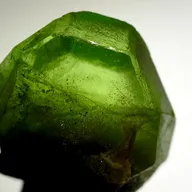 Peridot
Green olivine from the mantle, and occasionally from space.
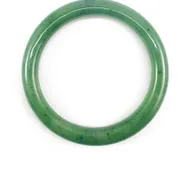 Jade
Two different minerals under one name, and the toughest stone on this page.
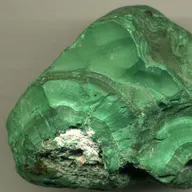 Malachite
Copper gone green, in bands you can read like tree rings.
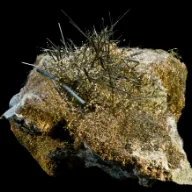 Actinolite
Green needles of amphibole, and the mineral half of all jade is made of.
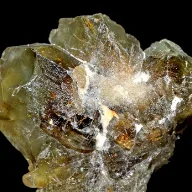 Alexandrite
Green by day and red by lamplight, and named for a tsar who was not yet one.
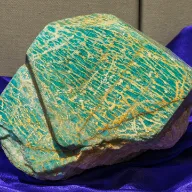 Amazonite
Green feldspar from a river it was never found in.
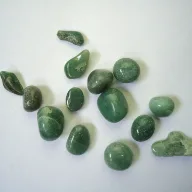 Aventurine
Quartz with a glitter of green mica through it, named by accident.
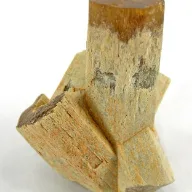 Beryl
One mineral, six famous names: emerald, aquamarine, morganite and the rest are all this.
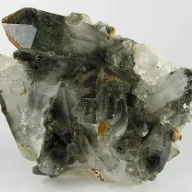 Chlorite
The green that gets into everything: a whole family of soft micaceous minerals, and the ghost inside phantom quartz.
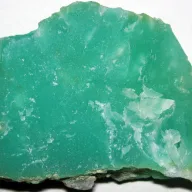 Chrysoprase
Apple-green chalcedony coloured by nickel, and the most valuable of all the quartzes.
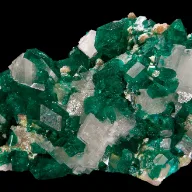 Dioptase
Copper green so convincing that the first crystals sent to Moscow were reported as emeralds.
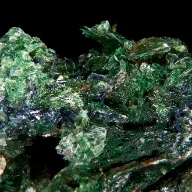 Fuchsite
Muscovite that took up chromium and turned green and glittering.
 Bloodstone
Dark green chalcedony spotted with red, and one of the two birthstones of March.
 Moldavite
Bohemian glass made by an asteroid hitting Germany fifteen million years ago.
 Prehnite
Green botryoidal crusts, usually with black epidote needles through them.
Saussurite
What a feldspar becomes when hot water gets at it for long enough.
 Vesuvianite
Named for the volcano that threw it out, and for looking like several other minerals at once.
 Zoisite
A grey-green rock mineral that produced two of the century's fashionable gems.