 Lunarya
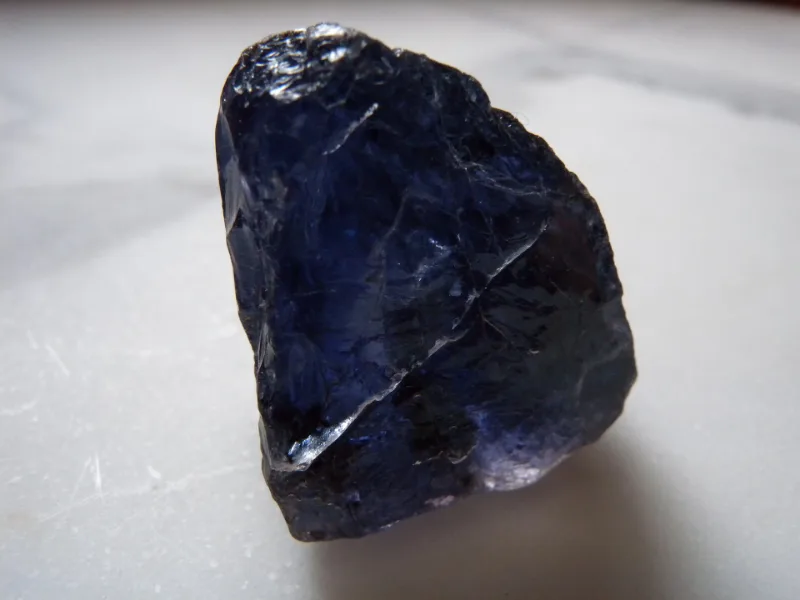
Iolite
Iolite is the gem trade name for cordierite, Mg₂Al₄Si₅O₁₈. Its peculiarity is pleochroism, and it has the strongest of any common gem: the same crystal is violet-blue looked at down one axis, nearly colourless down the second, and a yellow-grey down the third. Turn a cut stone and the colour changes. The name is from the Greek ion, violet, and the mineral name honours Louis Cordier, who described it in 1809.
It is hard, 7 to 7.5, but it has one direction of good cleavage, and a cutter has to orient the rough so that the blue faces up — a badly oriented iolite looks grey and washed out, which is why cheap stones so often disappoint. The old trade name is water sapphire, saphir d'eau, and older mineralogy calls it dichroite for the same reason everyone else calls it iolite. Some Indian material carries platelets of hematite that give a red glitter, sold as bloodshot iolite or iolite-sunstone.
In short
- Colour
- Blue
- Mineral
- Silicate
- Formula
- Mg₂Al₄Si₅O₁₈
- Hardness
- 7–7.5 on the Mohs scale
- Crystal system
- Orthorhombic
- Found in
- India, from Tamil Nadu and Andhra Pradesh, is the main gem source. Others are Sri Lanka, Madagascar, Tanzania, Myanmar, Brazil, Norway, Finland, Greenland, and Wyoming and Connecticut in the United States.
- Element
- Air
- Planet
- Saturn
- Chakra
- Third eye
- Handling
- Water and light are both fine
How it forms
Cordierite is the low-pressure indicator among the aluminium silicates. It grows where aluminium-rich rock is heated without being buried very deep — in hornfels around a granite intrusion, and in medium-grade schists and gneisses. Where kyanite says high pressure and andalusite says shallow and hot, cordierite says the rock was baked rather than crushed, and it keeps company with andalusite, sillimanite, garnet and biotite.
In human hands
Known as water sapphire long before Cordier named it, and cut in Europe as a cheap substitute for blue sapphire. Its fame now rests on a claim that deserves care: that Viking navigators used thin plates of iolite as a polarising filter to locate the sun through cloud. The sagas do mention a sunstone, Thorkild Ramskou proposed a polarising crystal in 1967, and the gem trade attached the story to iolite. The best physical evidence, including a crystal recovered from a sixteenth-century wreck off Alderney, points instead at Iceland spar, the clear calcite that has a page of its own here.
Varieties and trade names
- Gem iolite
- Faceted blue-violet stones, usually Indian or Sri Lankan, cut to put the blue axis face up.
- Bloodshot iolite
- Shot through with red hematite platelets, so the stone glitters copper against violet.
- Iolite-sunstone
- Indian material with enough hematite and goethite to show aventurescence across the whole stone.
- Cat's-eye iolite
- Rare material with fine parallel inclusions, cut as a cabochon to show a single band of light.
- Massive cordierite
- The grey metamorphic rock-forming material, common as dirt and of no interest to a jeweller.
Telling it from a fake
Turn it. Few stones change colour that strongly from one direction to another, and none of the usual blue imitations does it at all. Tanzanite is also pleochroic but runs blue to violet to burgundy, is softer, and is noticeably heavier. Sapphire is much harder and heavier again. Blue glass, spinel and synthetic quartz show a single colour from every angle. Iolite is also comparatively light in the hand for its size.
None of this needs a laboratory, and none of it is proof. A shop that will not say whether a stone is treated has answered the question; ask, and have the answer written on the receipt.
What it is said to do
Read as a stone of direction: knowing which way to go, seeing a situation as it is, and the older navigational story sitting behind all of it. It is given to Saturn, to Libra and Sagittarius, and to the third eye. The Viking-compass tale is the reason for most of this, so it seems only fair to say on the same page that the evidence favours calcite.
Living with it
Hard enough for a ring but it cleaves, so a knock on the edge of a faceted stone can start a split. Water and light are fine. No ultrasonic and no steam cleaner. Set it with protected corners, and store it apart from harder stones, which will scratch the polish and dull the colour change.
In magic
Iolite's magic follows the Viking navigator's story: modern practice uses it for finding direction — a stone held while deciding which way to go, or carried on a journey — and for inner journeys in meditation and divination. Since the evidence favours calcite as the Vikings' sunstone, iolite's claim is a borrowed one. It is safe in water and light.
- Energy
- Projective
- Day
- Saturday
- Worked for
- Study and clear thinking · Divination and intuition
More of this colour
 Aquamarine
Beryl the colour of shallow water, in crystals a metre long.
 Turquoise
The stone that takes up whatever you soak it in, including your hand cream.
 Lapis lazuli
A blue rock with gold in it, mined in one valley for six thousand years.
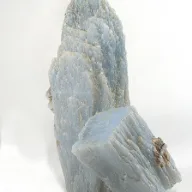 Angelite
Blue anhydrite from Peru: gypsum with the water taken out, and a name the trade gave it.
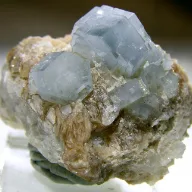 Apatite
The mineral teeth are made of, and the one that gives 5 on the Mohs scale its meaning.
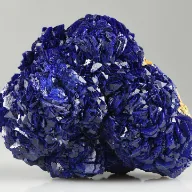 Azurite
The deep blue of copper, and the blue of half the paintings in Europe before 1700.
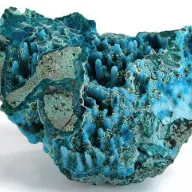 Chrysocolla
Copper turned to blue-green paste, and the flux that Bronze Age goldsmiths soldered with.
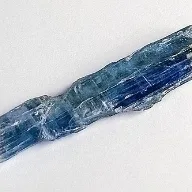 Kyanite
Blue blades with two hardnesses: soft along their length, hard across it.
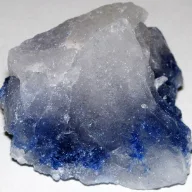 Dumortierite
A blue borosilicate that reaches the shops disguised as quartz.
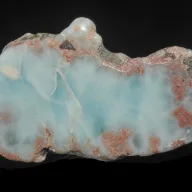 Larimar
Blue pectolite from one hillside in the Dominican Republic and nowhere else.
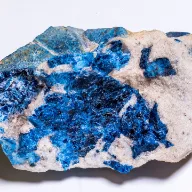 Lazulite
An azure phosphate with a name one letter away from lapis lazuli.
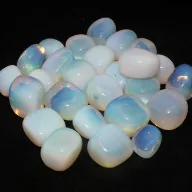 Opalite
Man-made glass, sold as a stone, and honestly rather pretty.
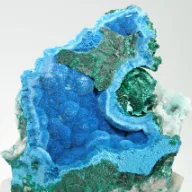 Shattuckite
A copper silicate in a blue that only copper manages, from a mine in Arizona.
 Sodalite
Royal blue veined with white, and the lapis on the shelf that is not lapis.