 Lunarya
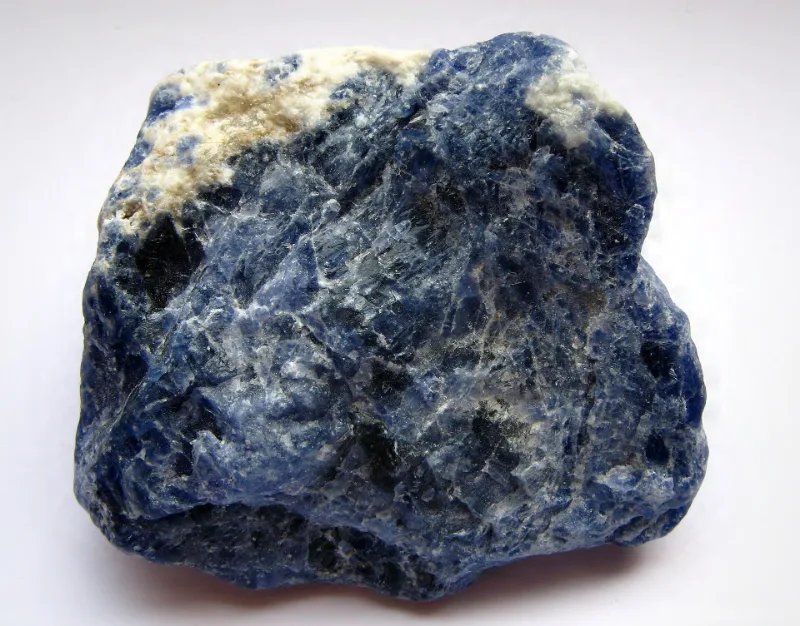
Sodalite
Sodalite is a sodium aluminium silicate with chlorine in it, Na₈Al₆Si₆O₂₄Cl₂, and it is one of the feldspathoids — minerals that grow where there was plenty of sodium and not enough silica to make feldspar. It is a strong royal blue, usually mottled and veined with white calcite, occasionally grey, green or pink. Hardness 5.5 to 6, and the name is simply its chemistry: soda, and lithos for stone.
It belongs to the same small group as lazurite, which is the blue of lapis lazuli, and that relationship is the source of endless confusion in shops. Lapis is a rock containing lazurite, and it carries pyrite; sodalite is a mineral, is softer, and never has pyrite in it. One variety of sodalite does something remarkable: hackmanite is tenebrescent, which means it changes colour under ultraviolet light and fades back in daylight, over and over, like a photochromic lens that takes hours instead of seconds.
In short
- Colour
- Blue
- Mineral
- Silicate
- Formula
- Na₈Al₆Si₆O₂₄Cl₂
- Hardness
- 5.5–6 on the Mohs scale
- Crystal system
- Cubic
- Found in
- Bancroft in Ontario, which produced the great Canadian material; Bahia in Brazil, the main commercial source today; Namibia at Swartbooisdrif; Greenland at Ilímaussaq, the type locality, where the hackmanite comes from too; Afghanistan, Russia, India and Italy at Vesuvius.
- Element
- Air
- Planet
- Jupiter
- Chakra
- Third eye
- Handling
- Water and light are both fine
How it forms
Sodalite is a mineral of alkaline igneous rocks — nepheline syenites and phonolites, the same silica-poor, sodium-rich family that produces aegirine, eudialyte and arfvedsonite, all of which have pages here. It also grows in the contact zones where those rocks have soaked into limestone. Its chlorine has to come from somewhere, which usually means a magma that assimilated evaporite or seawater-derived brine.
In human hands
Described in 1811 from Greenland. Its moment came in 1901, when a royal visitor admired the Bancroft stone — the story names a princess, and its tellers disagree about which — and tonnes of it were shipped to decorate Marlborough House in London; the material has been called princess blue ever since. Sodalite has been a carving and inlay stone since, and the crystal trade sells it as the affordable alternative to lapis, which is exactly what it is.
Varieties and trade names
- Princess blue
- The Bancroft material from Ontario, deep blue with white veining; the stone of the 1901 shipment.
- Hackmanite
- The tenebrescent variety: violet or pink under ultraviolet, fading to white or grey in daylight, repeatedly.
- Blue granite
- Sodalite-rich syenite from Namibia and Brazil, quarried in slabs for facing and worktops.
- Yellow sodalite
- A rare golden variety from Brazil, sold as sunset sodalite; little to do with the familiar blue.
- Lapis lazuli
- The rock it is most often sold as; it contains a sodalite-group mineral but is not this one, and has a page here.
Telling it from a fake
Against lapis lazuli: sodalite has no pyrite, its white veins are calcite rather than the fine grey-white matrix of lapis, and its blue is slightly more purple and more mottled. It is softer than lapis by a little and much softer than the dumortierite quartzite sold as blue quartz. Dyed material — dyed jasper and dyed howlite both stand in for it — holds colour in the cracks. If a lamp is available, hackmanite's colour change is conclusive for that variety.
None of this needs a laboratory, and none of it is proof. A shop that will not say whether a stone is treated has answered the question; ask, and have the answer written on the receipt.
What it is said to do
Read as a thinking stone: clear-headedness, ordering one's ideas, saying what one actually believes rather than what is expected, and calm attention through a long piece of work. It is placed at the third eye, under Jupiter, with Sagittarius and Virgo. The tradition is twentieth-century; it borrows some of lapis lazuli's much older reputation, which the two stones' resemblance made almost inevitable.
Living with it
Safe in water for short washes and stable in sunlight, though the calcite veins are softer than the blue and will etch if anything acidic touches them. Avoid ultrasonic cleaners, which can loosen the veining. It takes daily wear reasonably well in a pendant; a ring will scratch. Dyed material should be kept dry.
In magic
Sodalite is used in modern practice for clear thinking and calm speech: a palm stone held while writing, a piece on the desk for study, a stone carried to a meeting where one needs to say what one actually believes. It borrows some of lapis lazuli's reputation. The blue is safe in water and light, though its white calcite veins dislike acid.
- Energy
- Projective
- Day
- Thursday
- Worked for
- Study and clear thinking · Speaking and being heard · Calm and peace
More of this colour
 Aquamarine
Beryl the colour of shallow water, in crystals a metre long.
 Turquoise
The stone that takes up whatever you soak it in, including your hand cream.
 Lapis lazuli
A blue rock with gold in it, mined in one valley for six thousand years.
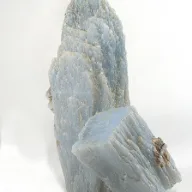 Angelite
Blue anhydrite from Peru: gypsum with the water taken out, and a name the trade gave it.
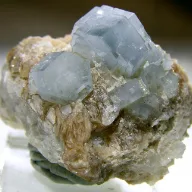 Apatite
The mineral teeth are made of, and the one that gives 5 on the Mohs scale its meaning.
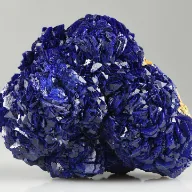 Azurite
The deep blue of copper, and the blue of half the paintings in Europe before 1700.
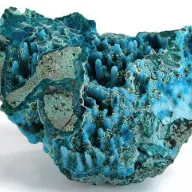 Chrysocolla
Copper turned to blue-green paste, and the flux that Bronze Age goldsmiths soldered with.
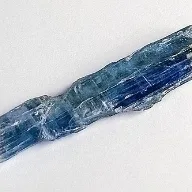 Kyanite
Blue blades with two hardnesses: soft along their length, hard across it.
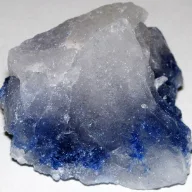 Dumortierite
A blue borosilicate that reaches the shops disguised as quartz.
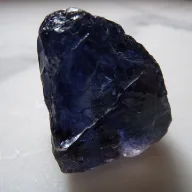 Iolite
Cordierite: violet-blue from one side, straw yellow from another.
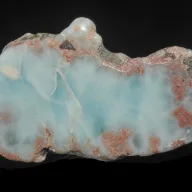 Larimar
Blue pectolite from one hillside in the Dominican Republic and nowhere else.
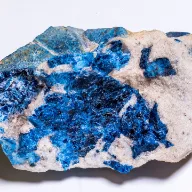 Lazulite
An azure phosphate with a name one letter away from lapis lazuli.
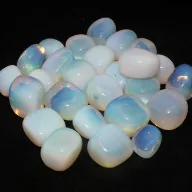 Opalite
Man-made glass, sold as a stone, and honestly rather pretty.
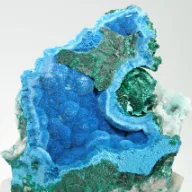 Shattuckite
A copper silicate in a blue that only copper manages, from a mine in Arizona.