 Lunarya
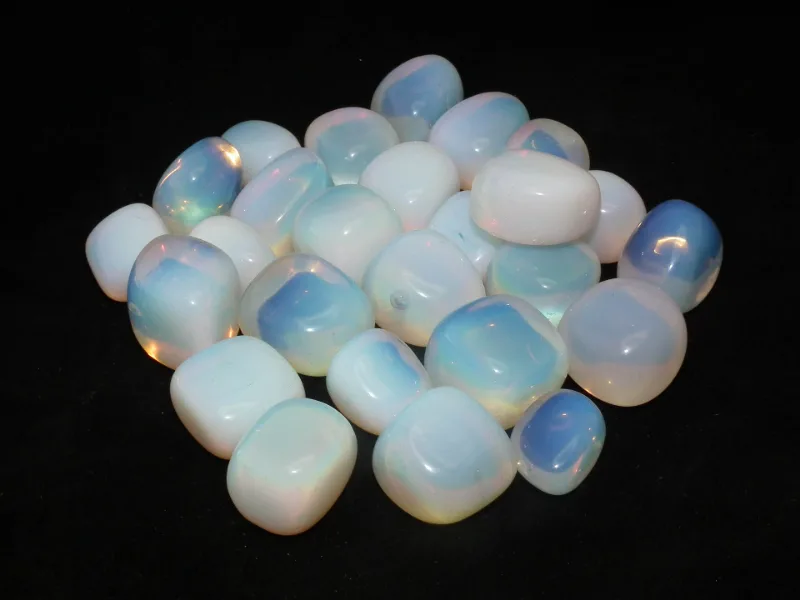
Opalite
Opalite is glass. It is manufactured — opalescent glass, made by adding a dispersing agent so that fine particles scatter the short wavelengths of light and let the long ones through, which is why a piece looks cool blue against a dark background and warm orange held up to a lamp. That effect has a name, the Tyndall effect, and it is a cousin of the scattering that makes the sky blue. Opalite is not opal, not moonstone, and not a mineral at all.
Saying so is the point of this page, because opalite is sold under a string of names that suggest otherwise: sea opal, opal moonstone, Tiffany stone in some shops, and occasionally as an ancient healing stone with an invented provenance. The material itself is unobjectionable — a well-made opalescent glass, hardness about 5 to 6, cheap, consistent and genuinely attractive. It only becomes a problem when someone pays gemstone prices for it. Geologists also use the word opalite for natural common opal and opalised rock, which is a separate and legitimate use and adds to the confusion.
In short
- Colour
- Blue
- Mineral
- Man-made, not a mineral
- Formula
- SiO₂
- Hardness
- 5–6 on the Mohs scale
- Crystal system
- None — it is a glass
- Found in
- Factories, mostly in China and India, and historically in the European and American glass industries, where opalescent glass has been made since the nineteenth century for lampshades, tableware and decorative panels.
- Element
- Water
- Planet
- The Moon
- Chakra
- Throat
- Handling
- Water and light are both fine
How it forms
Silica sand, soda and lime are melted together with an opacifier — fluoride, phosphate or tin compounds are traditional — and the melt is cooled in a way that lets microscopic droplets or crystallites separate out through the glass. Those particles do the scattering. Tumbling the cooled glass gives the rounded shapes a shop sells; slumping and moulding give spheres, towers and cabochons.
In human hands
Opalescent glass goes back to Roman experiments and became an industry in the nineteenth century, with Lalique and Tiffany both making famous versions. It arrived in the crystal trade in about the 1990s under the name opalite, and it has since become one of the most widely sold items in it, usually without any statement of what it is. Some sellers are straightforward; many are not, and a good number simply do not know.
Varieties and trade names
- Blue opalite
- The standard: milky blue in reflected light, warm orange transmitted; tumbles, spheres and towers.
- Sea opal
- The same glass in green, pink or lilac, coloured with metal oxides; a trade name, not a stone.
- Opalite points and wands
- Moulded or slumped shapes, which is how one can tell: glass pours and stone does not.
- Natural opalite
- The geological use of the word: common opal and opalised rock, from Utah and Nevada among other places.
- Moonstone
- The mineral opalite is most often confused with — feldspar, with a floating blue sheen; it has a page here.
Telling it from a fake
Look for bubbles. Round gas bubbles inside a translucent stone mean glass, and opalite usually has a few. Swirl marks and a perfectly even body colour say the same. It is also warmer to the touch than a mineral of the same size, and rings dull rather than bright when tapped. Real moonstone shows a sheen that floats at a particular angle from inside a crystal structure, not a uniform glow from the whole body.
None of this needs a laboratory, and none of it is proof. A shop that will not say whether a stone is treated has answered the question; ask, and have the answer written on the receipt.
What it is said to do
The readings given to it are gentle and unspecific: lightness, easing communication, smoothing a transition. It is filed at the throat, under the Moon, with Cancer and Pisces. Since the material was invented in a factory, none of this can be traditional, and the honest way to put it is that people find the glass calming to look at and hold, which is a real thing and does not need a false pedigree.
Living with it
Glass, so it chips and it scratches, but water, sunlight and warm hands do nothing to it. Wash it in soapy water, keep it out of the way of harder stones, and do not drop it on tile. It will not fade, will not dissolve and will outlive most of the shelf.
In magic
Opalite is glass, and the practitioners who use it are honest about that: it serves for calm, for easing communication and for transitions, a moon stone that costs little and survives anything. Its glow makes it a pretty focus for a full-moon meditation. As a manufactured material it has no tradition, which does not stop a glass sphere being a perfectly good thing to gaze into.
- Energy
- Receptive
- Day
- Monday
- Worked for
- Calm and peace · Speaking and being heard
More of this colour
 Aquamarine
Beryl the colour of shallow water, in crystals a metre long.
 Turquoise
The stone that takes up whatever you soak it in, including your hand cream.
 Lapis lazuli
A blue rock with gold in it, mined in one valley for six thousand years.
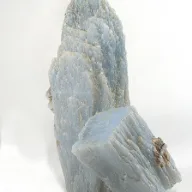 Angelite
Blue anhydrite from Peru: gypsum with the water taken out, and a name the trade gave it.
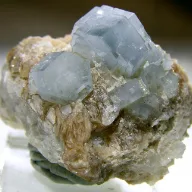 Apatite
The mineral teeth are made of, and the one that gives 5 on the Mohs scale its meaning.
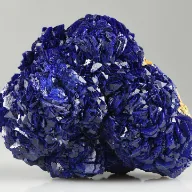 Azurite
The deep blue of copper, and the blue of half the paintings in Europe before 1700.
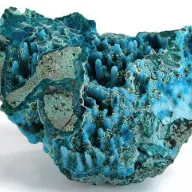 Chrysocolla
Copper turned to blue-green paste, and the flux that Bronze Age goldsmiths soldered with.
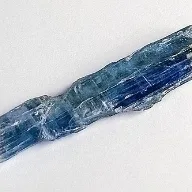 Kyanite
Blue blades with two hardnesses: soft along their length, hard across it.
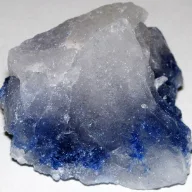 Dumortierite
A blue borosilicate that reaches the shops disguised as quartz.
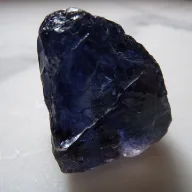 Iolite
Cordierite: violet-blue from one side, straw yellow from another.
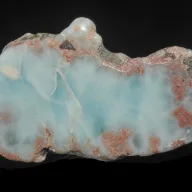 Larimar
Blue pectolite from one hillside in the Dominican Republic and nowhere else.
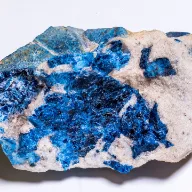 Lazulite
An azure phosphate with a name one letter away from lapis lazuli.
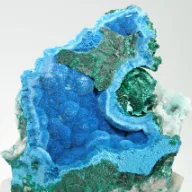 Shattuckite
A copper silicate in a blue that only copper manages, from a mine in Arizona.
 Sodalite
Royal blue veined with white, and the lapis on the shelf that is not lapis.