 Lunarya
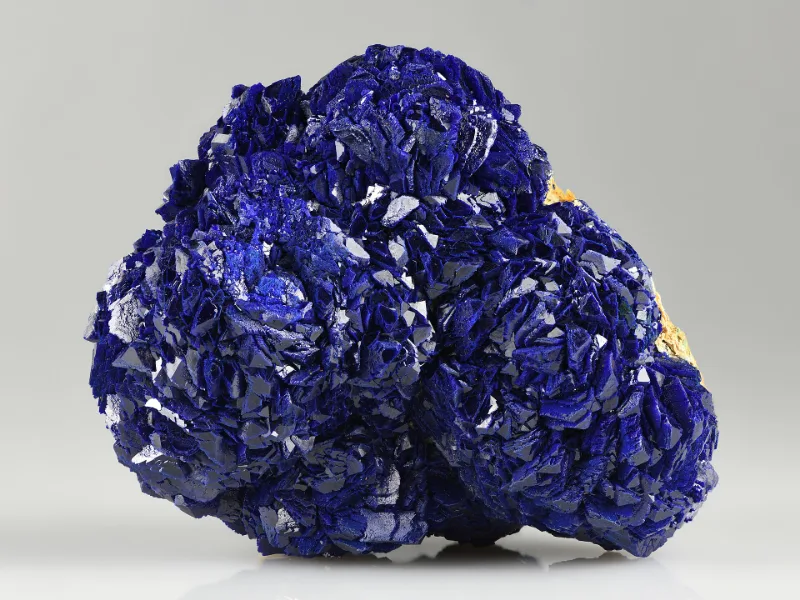
Azurite
Azurite is a copper carbonate, the deep blue that forms where copper ore weathers, and it is the twin of malachite, the green one: the same elements in slightly different proportion, grown side by side in the oxidised top of a copper deposit. Left in damp air for long enough it turns into malachite itself, which is why the blue skies of some old paintings have gone green.
It was the blue of medieval Europe. Lapis lazuli had to come from Afghanistan and cost more than gold; azurite came from the copper mines of Hungary and Germany, and it was ground into the blue of most panel paintings and manuscripts from the twelfth century until Prussian blue was invented in 1704 — the name, from the Persian for blue, is the same as lapis's. The crystals collectors want are from Bisbee in Arizona, Tsumeb in Namibia, Chessy near Lyon, whose name gave the old term chessylite, and the mines of Morocco.
In short
- Colour
- Blue
- Mineral
- Carbonate
- Formula
- Cu₃(CO₃)₂(OH)₂
- Hardness
- 3.5–4 on the Mohs scale
- Crystal system
- Monoclinic
- Found in
- Arizona (Bisbee, Morenci), Namibia (Tsumeb), Morocco (Touissit), Utah, Australia, France (Chessy), Mexico.
- Element
- Water
- Planet
- Jupiter
- Chakra
- Third eye
- Handling
- Keep out of water and sunlight
How it forms
When a copper sulfide ore body is lifted into the reach of rain, the sulfides break down, the copper goes into solution, and it comes out again as carbonates where the water meets limestone or carbon dioxide: azurite where there is a little less water and a little more carbon dioxide, malachite where there is more of the water. That is why the two grow together, why azurite is usually the older crystal with malachite forming on it, and why azurite is rarer — the conditions that make it are the narrower ones. The finest crystals grow in the open cavities of the oxidised zone, above the water table, in the desert mines of Arizona, Namibia and Morocco where the zone is deep and dry.
In human hands
The Egyptians used it as a pigment from the Fourth Dynasty, though their famous blue was a glass they made; Rome had it as caeruleum from the mines of Armenia and Cyprus. From the twelfth century it was the workhorse blue of European painting, mined in Saxony, Hungary and the Tyrol and sold as azzurro della Magna, German blue; nearly every blue robe and sky in a northern painting before 1700 is azurite, and where the painting has been damp the robe is now green. It went out of use when the copper mines of Germany failed and synthetic blues arrived, and came back in the nineteenth century as a specimen mineral, with Bisbee and Chessy giving the classic crystals.
Varieties and trade names
- Bisbee azurite
- The Arizona crystals, dark and lustrous, from the Copper Queen mine; the classic pieces of the nineteenth century.
- Azurite suns
- Flat blue discs of azurite grown in white kaolin at Malbunka in Australia, sold whole as a picture of a sun.
- Azurite–malachite
- The two carbonates grown together in blue and green bands, cut and polished, and the form most jewellery uses.
- Chessylite
- The old name for azurite, after Chessy-les-Mines near Lyon, whose crystals filled the cabinets of the 1800s.
Telling it from a fake
Azurite is soft, heavy and a blue so dark it is nearly black in a large crystal; a knife scratches it, it fizzes in a drop of vinegar, and where it has weathered it shows a green skin of malachite. Dyed howlite and reconstituted 'azurite' — powder in resin — are the fakes, and both are lighter and neither fizzes; the resin ones also smell of plastic when warmed. Lapis is harder, speckled with pyrite and does not fizz. Sodalite has no green anywhere on it. Polished azurite is often stabilised with resin to stop it crumbling, which is accepted and rarely mentioned.
None of this needs a laboratory, and none of it is proof. A shop that will not say whether a stone is treated has answered the question; ask, and have the answer written on the receipt.
What it is said to do
The stone of the inner eye in the lists, for the blue, and of study, for the medieval scholars whose books were painted with it: given for insight, for research and for the kind of intuition that comes from having read enough. The old lapidaries mostly confused it with lapis and gave it lapis's reputation, which the modern ones have kept.
Living with it
Keep it dry and out of the sun. Water and damp turn it green, light dulls it, and it is soft; wipe it with a dry cloth and handle it as little as the crystals allow.
In magic
Azurite was the blue of medieval manuscripts and altarpieces, and in modern practice it is a stone of the inner eye: used for divination, dream work and the insight that comes from study, often alongside lapis. It turns green in the damp and dulls in the light, and it is a copper mineral, so it stays on the altar, dry and unground.
- Energy
- Receptive
- Day
- Thursday
- Worked for
- Divination and intuition · Study and clear thinking
More of this colour
 Aquamarine
Beryl the colour of shallow water, in crystals a metre long.
 Turquoise
The stone that takes up whatever you soak it in, including your hand cream.
 Lapis lazuli
A blue rock with gold in it, mined in one valley for six thousand years.
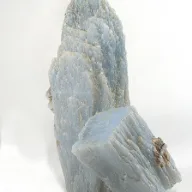 Angelite
Blue anhydrite from Peru: gypsum with the water taken out, and a name the trade gave it.
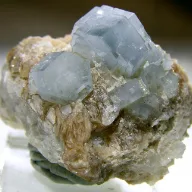 Apatite
The mineral teeth are made of, and the one that gives 5 on the Mohs scale its meaning.
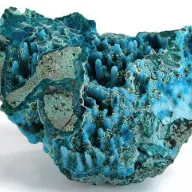 Chrysocolla
Copper turned to blue-green paste, and the flux that Bronze Age goldsmiths soldered with.
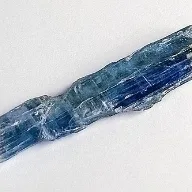 Kyanite
Blue blades with two hardnesses: soft along their length, hard across it.
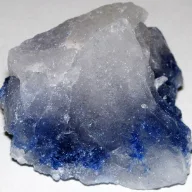 Dumortierite
A blue borosilicate that reaches the shops disguised as quartz.
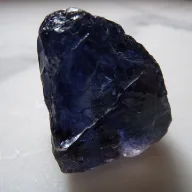 Iolite
Cordierite: violet-blue from one side, straw yellow from another.
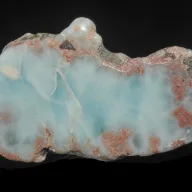 Larimar
Blue pectolite from one hillside in the Dominican Republic and nowhere else.
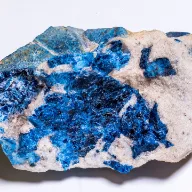 Lazulite
An azure phosphate with a name one letter away from lapis lazuli.
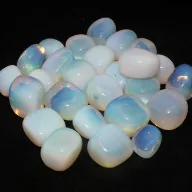 Opalite
Man-made glass, sold as a stone, and honestly rather pretty.
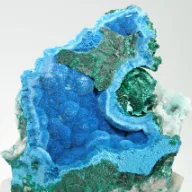 Shattuckite
A copper silicate in a blue that only copper manages, from a mine in Arizona.
 Sodalite
Royal blue veined with white, and the lapis on the shelf that is not lapis.