 Lunarya
Kyanite
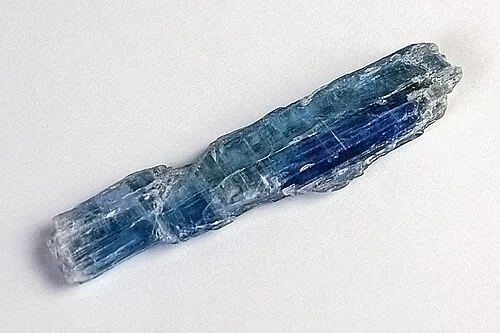
Kyanite is aluminium silicate, Al₂SiO₅, in long flat blades of a blue that no other rock-forming mineral manages: streaky, deepening towards the middle of the crystal, sometimes almost sapphire. Its famous peculiarity is that its hardness depends on direction. A steel point scratches a blade easily along its length and will not touch it across the blade, which is why the old name for it is disthene, two strengths.
It is one of the three minerals with this formula — the others are andalusite and sillimanite — and it is the high-pressure one. Finding kyanite in a rock tells a geologist that the rock was buried deep, which is why it turns up in eclogites and in the roots of old mountain chains. The blue comes from small amounts of iron and titanium; manganese gives the orange Tanzanian crystals, and vanadium the green. Industrially it is roasted to make mullite for furnace linings and spark plugs, and the United States mines around a hundred thousand tonnes of it a year for that.
In short
- Colour
- Blue
- Mineral
- Silicate
- Formula
- Al₂SiO₅
- Hardness
- 4.5–7 on the Mohs scale
- Crystal system
- Triclinic
- Found in
- Minas Gerais in Brazil, Nepal, Tanzania and Kenya, the Swiss Alps, Austria, India, Russia, and the Appalachians of North Carolina and Georgia.
- Element
- Air
- Planet
- Mercury
- Chakra
- Throat
- Handling
- Water and light are both fine
How it forms
Kyanite grows when a clay-rich sediment is buried deep and squeezed: aluminium-rich rocks at high pressure and moderate temperature produce it in schists and gneisses, often with garnet, staurolite and mica. The showy crystals come from quartz veins that opened in those schists while they were still hot, where the blades had room to grow. Which of the three polymorphs a rock contains maps directly onto where it sat in the crust, and geologists use the boundary between them as a pressure gauge for whole mountain belts.
In human hands
Werner named it in 1789 from the Greek kyanos, dark blue. For a century it was of interest only to petrologists, since the varying hardness makes it awkward to cut and the cleavage makes it awkward to set. Two things changed that: the refractories industry, which has used it since the 1920s, and the crystal trade of the 1980s, which took to it in a large way. Gem-quality blue kyanite from Nepal, first cut in quantity in the 1990s, is now a recognised if difficult jeweller's stone.
Varieties and trade names
- Blue kyanite
- The familiar one, in blades and fans; the best transparent material comes from Nepal and Brazil.
- Black kyanite
- Opaque dark grey-black fans from Brazil, sold as brooms or fans and popular in the crystal trade.
- Orange kyanite
- Small manganese-bearing crystals from Tanzania, bright apricot and genuinely rare.
- Green kyanite
- Vanadium-coloured, also Tanzanian, and rarer still; often mistaken for tourmaline.
- Andalusite and sillimanite
- The same formula at lower pressure and higher temperature; chiastolite, on its own page here, is an andalusite.
Telling it from a fake
The two hardnesses settle it: scratch an inconspicuous spot along the blade with a knife and it marks, then try across the blade and it will not. The blades are flat and splintery with a pearly sheen on the cleavage, and the colour is uneven, running in streaks. Blue tourmaline and sapphire are far harder throughout; dyed blue quartzite and howlite take colour into their cracks. Black kyanite fans are unmistakable, and nothing bothers to imitate them.
None of this needs a laboratory, and none of it is proof. A shop that will not say whether a stone is treated has answered the question; ask, and have the answer written on the receipt.
What it is said to do
Given for alignment and for saying what one means: the standard modern reading puts it at the throat and calls it a stone of straight speech and of getting one's various intentions pointing the same way. Nearly every book adds that kyanite never needs cleansing and never holds negative energy, a claim that has been repeated so often it is treated as a property of the mineral; it is a convention of the literature rather than an observation.
Living with it
Cleaves and splinters, so handle the blades by the flat and keep them out of pockets. Water is fine and sunlight does no harm. Do not use an ultrasonic cleaner, and if you wear it, choose a setting that protects the edges — a kyanite ring worn every day will not survive long.
In magic
Kyanite is used in modern practice for alignment and straight speech: a blade laid at the throat or held in meditation, or set in a grid to bring different intentions into line. The books' favourite claim, that it never needs cleansing, is a convention rather than an observation, but a convenient one for a stone that is safe in water and light anyway. It splinters, so it is held by the flat.
- Energy
- Projective
- Day
- Wednesday
- Worked for
- Speaking and being heard · Study and clear thinking
More of this colour
 Aquamarine
Beryl the colour of shallow water, in crystals a metre long.
 Turquoise
The stone that takes up whatever you soak it in, including your hand cream.
 Lapis lazuli
A blue rock with gold in it, mined in one valley for six thousand years.
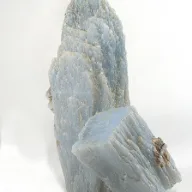 Angelite
Blue anhydrite from Peru: gypsum with the water taken out, and a name the trade gave it.
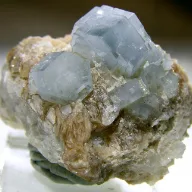 Apatite
The mineral teeth are made of, and the one that gives 5 on the Mohs scale its meaning.
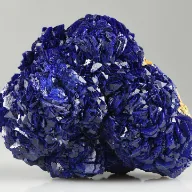 Azurite
The deep blue of copper, and the blue of half the paintings in Europe before 1700.
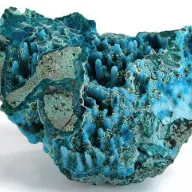 Chrysocolla
Copper turned to blue-green paste, and the flux that Bronze Age goldsmiths soldered with.
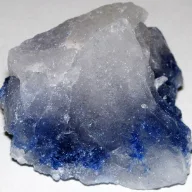 Dumortierite
A blue borosilicate that reaches the shops disguised as quartz.
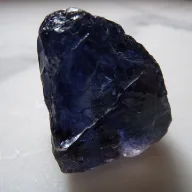 Iolite
Cordierite: violet-blue from one side, straw yellow from another.
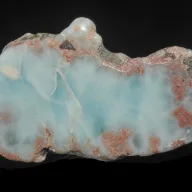 Larimar
Blue pectolite from one hillside in the Dominican Republic and nowhere else.
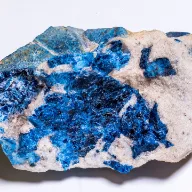 Lazulite
An azure phosphate with a name one letter away from lapis lazuli.
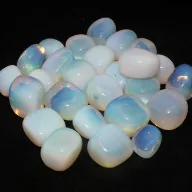 Opalite
Man-made glass, sold as a stone, and honestly rather pretty.
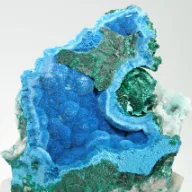 Shattuckite
A copper silicate in a blue that only copper manages, from a mine in Arizona.
 Sodalite
Royal blue veined with white, and the lapis on the shelf that is not lapis.