 Lunarya
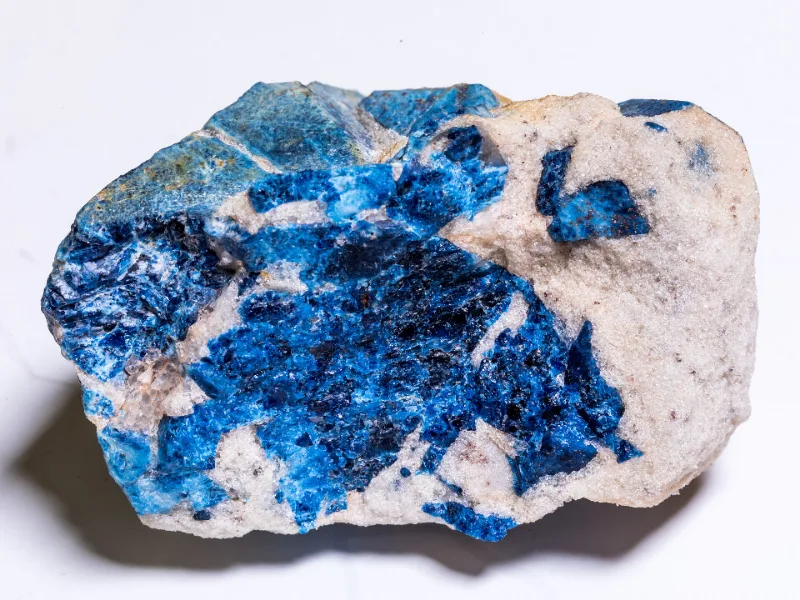
Lazulite
Lazulite is a magnesium aluminium phosphate, MgAl₂(PO₄)₂(OH)₂, and it is one of the strongest blues in the mineral kingdom: azure to indigo, sometimes almost navy, in sharp wedge-shaped crystals. Its name comes through medieval Latin from the Arabic for sky, and that is the whole of the confusion with lazurite, the blue mineral of lapis lazuli, which is a completely different chemistry with a nearly identical name.
It forms a complete series with scorzalite, in which iron replaces the magnesium; the more iron, the darker and greener the blue. Hardness 5.5 to 6, brittle, with an indistinct cleavage, and the crystals are strongly pleochroic — turn a transparent one and it goes from deep blue to nearly colourless. Faceted lazulite exists but is a collector's curiosity, since clean transparent material bigger than a carat or two is very rare. Most specimens are opaque crystals embedded in white quartz, which is a good part of their appeal.
In short
- Colour
- Blue
- Mineral
- Phosphate
- Formula
- MgAl₂(PO₄)₂(OH)₂
- Hardness
- 5.5–6 on the Mohs scale
- Crystal system
- Monoclinic
- Found in
- Graves Mountain in Georgia and Rapid Creek in the Yukon are the two famous localities; the Yukon crystals are the best in the world. Others are Werfen and the Styrian Alps in Austria, Brazil, Madagascar, Sweden, Switzerland and California.
- Element
- Air
- Planet
- Mercury
- Chakra
- Third eye
- Handling
- Water and light are both fine
How it forms
A mineral of phosphate-bearing metamorphic rocks and of the quartz veins that cut them: aluminium-rich sediments with phosphate in them, heated and squeezed, produce lazulite alongside kyanite, rutile, pyrophyllite and andalusite. The spectacular Yukon crystals grew instead in open cavities in an iron formation, where fluid could deposit them slowly with nothing in the way.
In human hands
Named in 1795 by Martin Klaproth. It has never had a commercial use: too rare to be an ore of anything, too brittle and too scarce to be a gem, and too easily mistaken for other blue minerals to have built a trade name. It reached the crystal market only in the last thirty years, largely on the strength of specimens from Rapid Creek reaching mineral shows in the 1980s and 1990s.
Varieties and trade names
- Rapid Creek lazulite
- Yukon crystals, sharp and glassy and sometimes gem-clear; the standard against which the mineral is judged.
- Graves Mountain lazulite
- Georgia material, blue crystals in white quartz with rutile and pyrophyllite; handsome and widely collected.
- Scorzalite
- The iron end of the same series, darker and greener; the two cannot be told apart by eye.
- Lazulite quartzite
- Massive blue-flecked rock from Brazil and Madagascar, cut into cabochons and beads.
- Lazurite
- The other stone: the blue of lapis lazuli, a feldspathoid, softer and a different mineral entirely.
Telling it from a fake
The crystal habit settles it: lazulite grows in sharp double wedges, which almost nothing else blue does. Lapis lazuli is a rock, softer, with pyrite and calcite in it, and never shows a crystal face. Azurite is a carbonate and fizzes in acid; lazulite does not. Sodalite is lighter and softer. If a transparent crystal changes from strong blue to near-colourless as it is turned, that is pleochroism and it is very good evidence.
None of this needs a laboratory, and none of it is proof. A shop that will not say whether a stone is treated has answered the question; ask, and have the answer written on the receipt.
What it is said to do
A modern reading, and a quiet one: clarity of thought, honesty about what one actually knows, and the kind of attention a long piece of study needs. It is filed at the third eye, under Mercury, with Gemini and Sagittarius. There is no older tradition, and any book that gives it one has probably confused it with lapis lazuli, which has several thousand years of tradition and a very similar name.
Living with it
Water and light do it no harm. It is brittle rather than soft, so the risk is chipping a crystal edge rather than scratching a face; keep specimens where they cannot knock together. Cut stones want a protected setting. No ultrasonic, because of the cleavage and the fractures most crystals carry.
In magic
Lazulite has no magic of its own; the books that list it give it to clear thinking and honest study, and it is often confused with lapis lazuli, which has the tradition. It is brittle, so it is set down rather than carried, but water and light do it no harm.
- Energy
- Projective
- Day
- Wednesday
- Worked for
- Study and clear thinking
More of this colour
 Aquamarine
Beryl the colour of shallow water, in crystals a metre long.
 Turquoise
The stone that takes up whatever you soak it in, including your hand cream.
 Lapis lazuli
A blue rock with gold in it, mined in one valley for six thousand years.
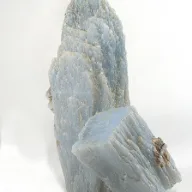 Angelite
Blue anhydrite from Peru: gypsum with the water taken out, and a name the trade gave it.
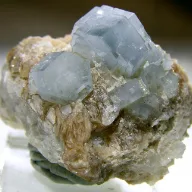 Apatite
The mineral teeth are made of, and the one that gives 5 on the Mohs scale its meaning.
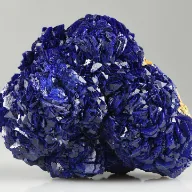 Azurite
The deep blue of copper, and the blue of half the paintings in Europe before 1700.
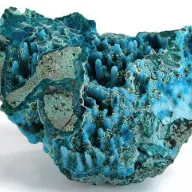 Chrysocolla
Copper turned to blue-green paste, and the flux that Bronze Age goldsmiths soldered with.
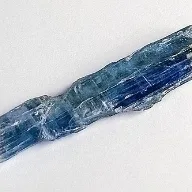 Kyanite
Blue blades with two hardnesses: soft along their length, hard across it.
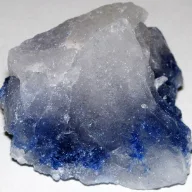 Dumortierite
A blue borosilicate that reaches the shops disguised as quartz.
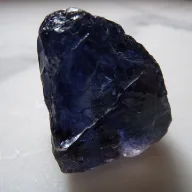 Iolite
Cordierite: violet-blue from one side, straw yellow from another.
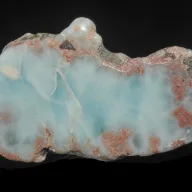 Larimar
Blue pectolite from one hillside in the Dominican Republic and nowhere else.
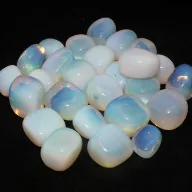 Opalite
Man-made glass, sold as a stone, and honestly rather pretty.
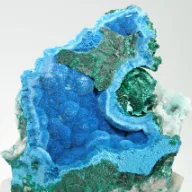 Shattuckite
A copper silicate in a blue that only copper manages, from a mine in Arizona.
 Sodalite
Royal blue veined with white, and the lapis on the shelf that is not lapis.