 Lunarya
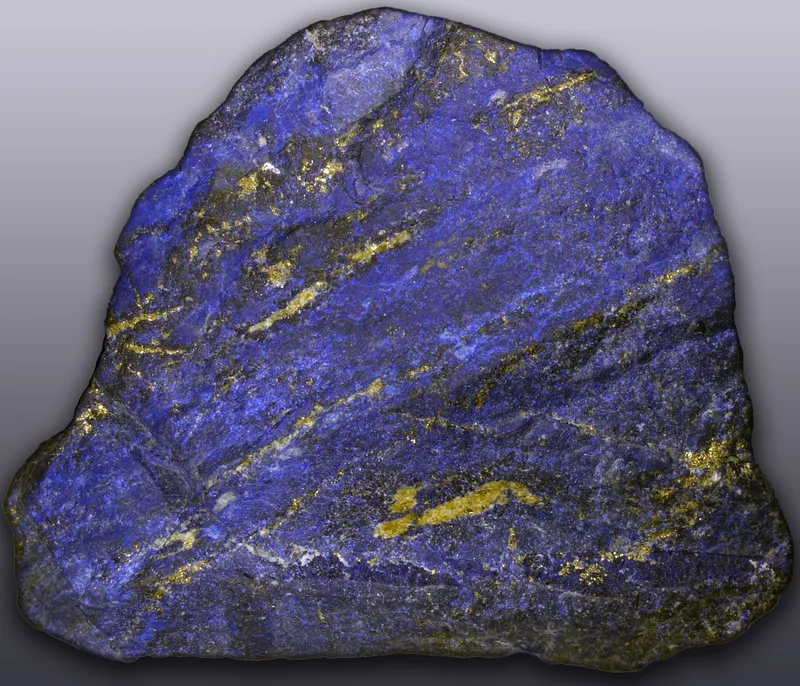
Lapis lazuli
Lapis is a rock rather than a single mineral: deep blue lazurite mixed with white calcite and flecks of brassy pyrite, and the best of it is even blue with just enough pyrite to glitter. The blue comes from sulfur trapped in the lazurite structure, which is an unusual way for a mineral to get its colour.
Almost all the lapis of the ancient world came from the Sar-e-Sang mines in Badakhshan, in north-eastern Afghanistan, worked continuously for over six thousand years and still producing. It travelled to Egypt, Sumer and the Indus, was inlaid into Tutankhamun's mask, and from the Middle Ages was ground into ultramarine, a pigment so costly that contracts specified who paid for it — until Guimet synthesised it in 1826 and a colour worth more than gold became a tube of paint.
In short
- Colour
- Blue
- Mineral
- A rock, not one mineral
- Formula
- (Na,Ca)₈(AlSiO₄)₆(SO₄,S,Cl)₂
- Hardness
- 5–5.5 on the Mohs scale
- Crystal system
- Cubic
- Found in
- Afghanistan above all, with lesser material from Chile and Siberia.
- Element
- Air
- Planet
- Jupiter
- Chakra
- Third eye
- Handling
- Keep out of water
How it forms
Lapis is a rock, not a mineral: blue lazurite, whose colour comes from a sulfur ion trapped in the cages of its structure, mixed with white calcite and brassy pyrite, sometimes with diopside and sodalite. It forms where a body of granite bakes an impure limestone, at several hundred degrees, and sulfur, sodium and silica move between them. The combination is rare enough that one valley, the Kokcha in Badakhshan, Afghanistan, has been the world's source for six thousand years, with lesser deposits at Lake Baikal, in the Chilean Andes, in Pakistan and Colorado. The best has the deepest blue, little calcite and a scatter of pyrite.
In human hands
It crossed three and a half thousand kilometres to Sumer, where Puabi's headdress and the Standard of Ur are made of it, and to Egypt, where it lines the eyes of Tutankhamun's mask and was called the hair of the gods. Ground and purified, it became ultramarine, from beyond the sea, the blue of the Virgin's robe in every altarpiece that could afford it, at a price above gold; Vermeer used it on a girl's turban and died in debt. In 1826 a synthetic ultramarine was made in France and the trade in the pigment ended in a decade. The stone itself went on to the Winter Palace, in a room of it.
Varieties and trade names
- Afghan
- From Sar-e-Sang in Badakhshan: the deepest blue, the least calcite, and the standard everything else is judged against.
- Chilean
- Paler, with more white calcite through it, and much of what goes into cheaper beads and carvings.
- Siberian
- From Lake Baikal, violet-blue and mixed, mined for the Russian palaces and rarely seen outside them.
- Denim lapis
- The pale, calcite-heavy grade, named for the colour of worn jeans; genuine, cheap, and often dyed to look like better.
Telling it from a fake
The classic substitutes are dyed jasper, once sold as Swiss lapis, uniform and without pyrite; sodalite, a real blue mineral, darker and veined in white but with no gold in it; and the Gilson synthetic, with its pyrite too evenly sprinkled. Real lapis is blue in uneven grains, has its pyrite in irregular flecks and veins, and usually a little white calcite it would rather you did not notice. Low grades are dyed and waxed to hide the calcite: acetone on a swab picks up the dye, and the colour pools in cracks. It is soft, and a knife will mark it.
None of this needs a laboratory, and none of it is proof. A shop that will not say whether a stone is treated has answered the question; ask, and have the answer written on the receipt.
What it is said to do
The stone of insight and of speaking with authority — it was the stone of judges and scribes in Egypt, and the modern reading keeps that: it is given for study, for telling the truth, and for the confidence to say what you actually think.
Living with it
Porous and only about 5 on the Mohs scale. Wipe it dry, keep it out of water and acids, and treat a polished piece gently — it scratches against quartz, which is most of the rest of the cabinet.
In magic
Lapis is among the oldest magical stones on record: in the Sumerian descent of Inanna, the goddess goes down into the underworld wearing lapis beads and carrying a measuring rod of lapis, and Egyptian amulets and scarabs were carved from it. Modern practice uses it for truth, wisdom and study, for speaking with authority, and in divination. It is porous, so it stays out of water and salt.
- Energy
- Projective
- Day
- Thursday
More of this colour
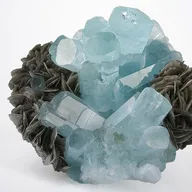 Aquamarine
Beryl the colour of shallow water, in crystals a metre long.
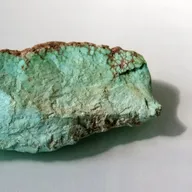 Turquoise
The stone that takes up whatever you soak it in, including your hand cream.
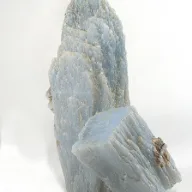 Angelite
Blue anhydrite from Peru: gypsum with the water taken out, and a name the trade gave it.
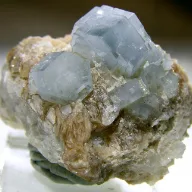 Apatite
The mineral teeth are made of, and the one that gives 5 on the Mohs scale its meaning.
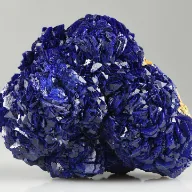 Azurite
The deep blue of copper, and the blue of half the paintings in Europe before 1700.
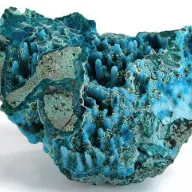 Chrysocolla
Copper turned to blue-green paste, and the flux that Bronze Age goldsmiths soldered with.
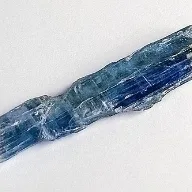 Kyanite
Blue blades with two hardnesses: soft along their length, hard across it.
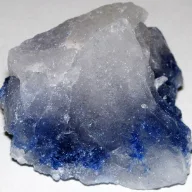 Dumortierite
A blue borosilicate that reaches the shops disguised as quartz.
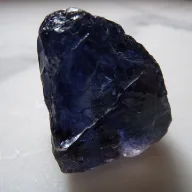 Iolite
Cordierite: violet-blue from one side, straw yellow from another.
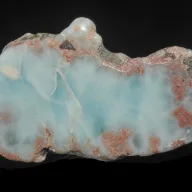 Larimar
Blue pectolite from one hillside in the Dominican Republic and nowhere else.
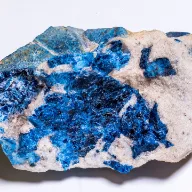 Lazulite
An azure phosphate with a name one letter away from lapis lazuli.
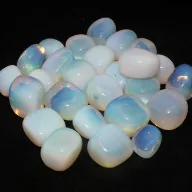 Opalite
Man-made glass, sold as a stone, and honestly rather pretty.
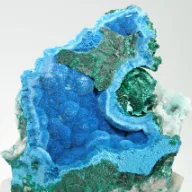 Shattuckite
A copper silicate in a blue that only copper manages, from a mine in Arizona.
 Sodalite
Royal blue veined with white, and the lapis on the shelf that is not lapis.