 Lunarya
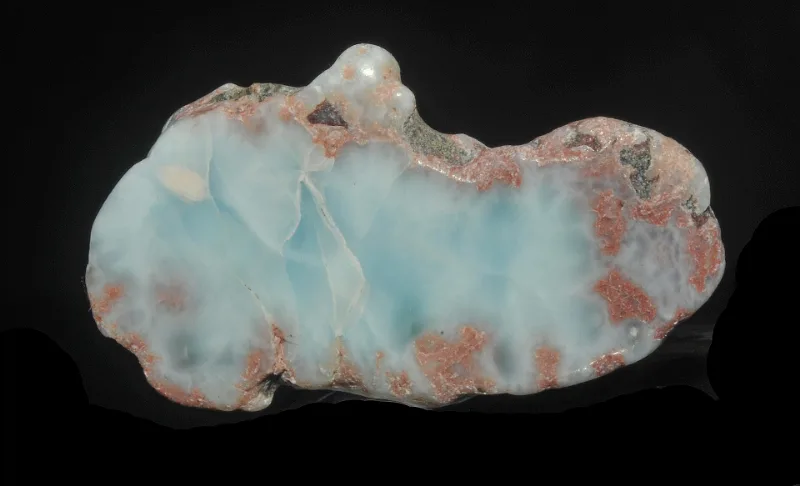
Larimar
Larimar is pectolite, NaCa₂Si₃O₈(OH), in a blue that pectolite has no business being. Ordinary pectolite is white and grows in needles; this one is sky blue to sea green, mottled with white, and the colour is copper sitting where calcium should be. It comes from a single mineralised zone in the mountains above Barahona in the Dominican Republic, and from nowhere else on Earth.
Hardness 4.5 to 5, which is soft for a stone that is mostly sold set in silver, and the fibrous structure means it takes a good polish but chips at an edge. The best material is a strong even blue; the ordinary grade is patchy, with white blotches and red-brown iron staining from the surrounding rock. Both the colour and the mineral are unstable in the wrong conditions: prolonged sunlight fades larimar, and heat will do it faster, which is why a piece left on a car dashboard comes back grey-green.
In short
- Colour
- Blue
- Mineral
- Silicate
- Formula
- NaCa₂Si₃O₈(OH)
- Hardness
- 4.5–5 on the Mohs scale
- Crystal system
- Triclinic
- Found in
- Los Chupaderos, in the Sierra de Bahoruco above Barahona, Dominican Republic — one working, a few hundred metres across, and the only commercial source in the world. Water-worn pebbles turn up on the beaches downstream, which is how it was found in the first place.
- Element
- Water
- Planet
- Neptune
- Chakra
- Throat
- Handling
- Fades in sunlight
How it forms
Basaltic lava erupted onto the sea floor and cooled with gas cavities in it. Hot water moving through the rock afterwards filled those cavities with pectolite, and where the fluid carried copper the pectolite grew blue. The deposit sits in an altered volcanic pile, and the blue zones are pockets and veins in it rather than a continuous seam, which is why the mine is a warren of small shafts rather than an open pit.
In human hands
Local people knew the beach pebbles long before anyone mined them; a Dominican priest applied for permission to work the stone in 1916 and was refused. The modern story starts in 1974, when Miguel Méndez and the American volunteer Norman Rilling traced the pebbles up the river to the source. Méndez named it for his daughter Larissa and the Spanish word for sea, mar. Fifty years on it is the country's signature stone and a significant part of the tourist trade.
Varieties and trade names
- Volcanic blue
- The top grade: deep even blue with little white, and priced accordingly.
- Marbled larimar
- Blue and white in a turtle-shell pattern; the most familiar look and the bulk of the market.
- Green larimar
- Sea-green rather than sky-blue, from zones where the copper content is lower.
- Larimar with hematite
- Rust-red staining through the blue, from iron in the surrounding basalt; disliked by dealers, liked by some collectors.
- White pectolite
- The ordinary mineral, in radiating white needles, from Italy, Canada, New Jersey and many other places.
Telling it from a fake
The pattern is the test: real larimar is mottled and fibrous, with white patches that have soft edges and a faint silky sheen where the needles catch the light. Dyed howlite and dyed magnesite are even in colour with the dye concentrated in the veins. Blue plastic and glass are warm to the touch and too uniform. Amazonite is harder and has flat cleavage flashes. Chrysocolla is softer, greener, and usually more copper-bright.
None of this needs a laboratory, and none of it is proof. A shop that will not say whether a stone is treated has answered the question; ask, and have the answer written on the receipt.
What it is said to do
Read as a stone of calm and of speaking plainly without heat: it goes to the throat, to Neptune, and to Pisces. The tradition is entirely modern — the stone has been known for fifty years — and much of it was assembled in the 1980s around a claim by Edgar Cayce that a blue stone would be found on a Caribbean island. The claim came first and the stone was fitted to it afterwards, which is worth knowing.
Living with it
Keep it out of the sun. That is the one rule that matters, because the blue genuinely fades, and no amount of care afterwards brings it back. Water is fine for brief washing but not for soaking, since the stone is porous in places. Avoid ultrasonic cleaners and steam, take rings off before anything abrasive, and store it in the dark.
In magic
Larimar came into practice in the 1980s on the strength of Edgar Cayce's prophecy of a blue Atlantean stone, and is used for calm, for speaking without heat, and in sea and water workings. It comes from the Dominican Republic and nowhere else. Keep it out of the sun, which fades it, and out of long baths.
- Energy
- Receptive
- Day
- Thursday
- Worked for
- Calm and peace · Speaking and being heard
More of this colour
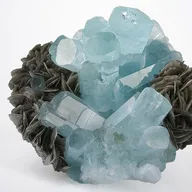 Aquamarine
Beryl the colour of shallow water, in crystals a metre long.
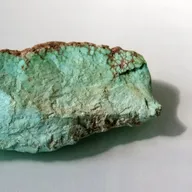 Turquoise
The stone that takes up whatever you soak it in, including your hand cream.
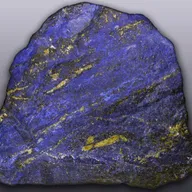 Lapis lazuli
A blue rock with gold in it, mined in one valley for six thousand years.
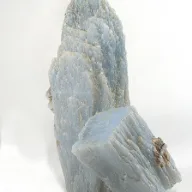 Angelite
Blue anhydrite from Peru: gypsum with the water taken out, and a name the trade gave it.
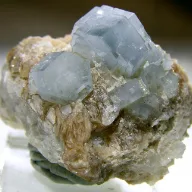 Apatite
The mineral teeth are made of, and the one that gives 5 on the Mohs scale its meaning.
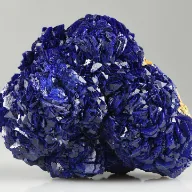 Azurite
The deep blue of copper, and the blue of half the paintings in Europe before 1700.
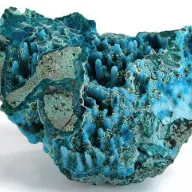 Chrysocolla
Copper turned to blue-green paste, and the flux that Bronze Age goldsmiths soldered with.
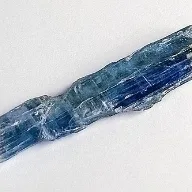 Kyanite
Blue blades with two hardnesses: soft along their length, hard across it.
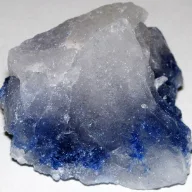 Dumortierite
A blue borosilicate that reaches the shops disguised as quartz.
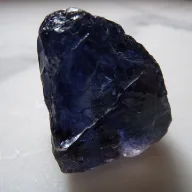 Iolite
Cordierite: violet-blue from one side, straw yellow from another.
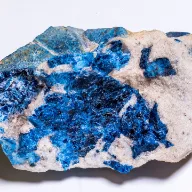 Lazulite
An azure phosphate with a name one letter away from lapis lazuli.
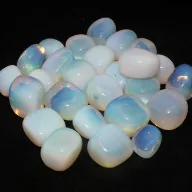 Opalite
Man-made glass, sold as a stone, and honestly rather pretty.
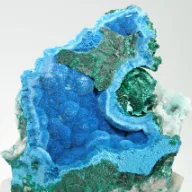 Shattuckite
A copper silicate in a blue that only copper manages, from a mine in Arizona.
 Sodalite
Royal blue veined with white, and the lapis on the shelf that is not lapis.