 Lunarya
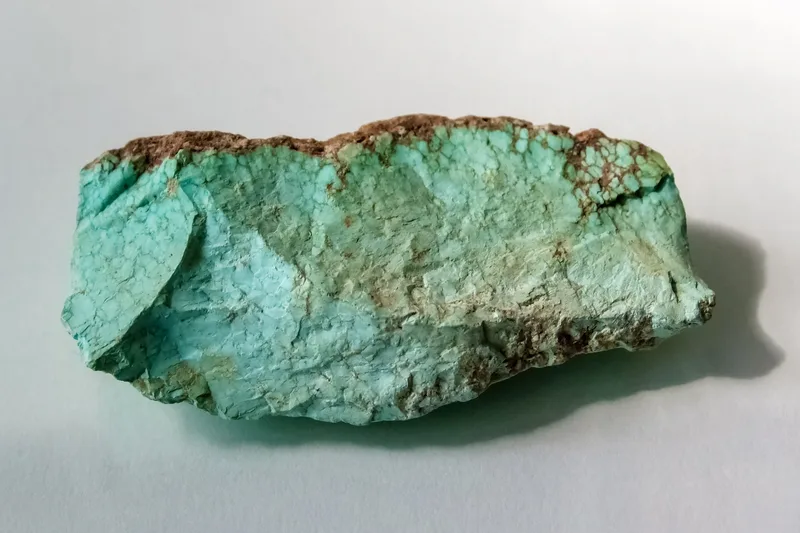
Turquoise
A hydrated phosphate of copper and aluminium that forms in dry, weathered rock where groundwater has run through copper ore — which is why it comes from deserts. Copper makes it blue and iron pushes it towards green. It is soft, porous and full of the host rock, whose dark veins are the matrix people either want or pay extra to avoid.
It has been mined for six thousand years, in Sinai by the Egyptians and at Nishapur in Persia, where the finest even blue still takes its name from the town. It reached Europe through Turkish traders, which is all the name means: pierre turquoise, the Turkish stone. Its porosity is its whole story — untreated turquoise slowly absorbs skin oils and darkens, which is why most stones on the market today are stabilised with resin, and why heirloom pieces are often green.
In short
- Colour
- Blue
- Mineral
- Phosphate
- Formula
- CuAl₆(PO₄)₄(OH)₈·4H₂O
- Hardness
- 5–6 on the Mohs scale
- Crystal system
- Triclinic
- Found in
- Iran, the American Southwest (Arizona, Nevada, New Mexico), China and Egypt.
- Birthstone of
- December
- Element
- Water
- Planet
- Jupiter
- Chakra
- Throat
- Handling
- Keep out of water and sunlight
How it forms
Turquoise forms near the surface in dry country, where acid groundwater leaches copper out of an ore body and phosphorus out of the rock and drops both into the cracks of the weathered host, as veins, seams and nodules; it almost never makes a crystal you can see. Copper is the blue; iron in place of aluminium turns it green; the host rock left in the seams is the matrix, and a fine net of it is spiderweb. Being porous and formed in the weather, it soaks up skin oil and changes colour with wear. Nishapur in Iran has been worked for two thousand years, and most American turquoise is a by-product of copper mining.
In human hands
Four bracelets of turquoise and gold on the arm of a queen buried at Abydos around 3000 BC are among the oldest jewellery known, and the Egyptians mined it in the Sinai under the goddess Hathor, Lady of Turquoise. It is Persia's national stone, on domes and in the name pirouzeh, victory, and the English word is French for Turkish, because it came through Turkey. The Aztecs built masks and serpents of turquoise mosaic; the Ancestral Puebloans worked it at Chaco Canyon a thousand years ago; and Navajo and Zuni silversmiths made it the stone of the American Southwest from the 1880s on. December has it.
Varieties and trade names
- Persian
- From Nishapur, in the robin's-egg blue with little matrix that has been the standard since the Middle Ages.
- Sleeping Beauty
- The clean, matrix-free sky blue of one Arizona mine, closed in 2012 and priced accordingly.
- Spiderweb
- Blue held in a fine net of dark matrix; Kingman in Arizona is the common one, and Nevada's Lander Blue the rarest turquoise there is.
- Hubei
- Chinese, and most of what is sold today: greener and more veined, and often stabilised with resin before it is cut.
Telling it from a fake
The most imitated stone on these pages. Dyed howlite and magnesite are white minerals with grey veins, dyed blue: scratch a hidden spot and it is white underneath, and acetone on a cotton bud lifts the colour. Block turquoise is powder in resin, too even and too light. Plastic is warm and light. Real turquoise is cold, heavier than it looks, slightly waxy, faintly uneven in colour, and its veins wander. Most genuine turquoise sold is stabilised, soaked in resin so it does not crumble or discolour, which is honest if it says so; natural, in the trade, means untreated, and is rare and priced like it.
None of this needs a laboratory, and none of it is proof. A shop that will not say whether a stone is treated has answered the question; ask, and have the answer written on the receipt.
What it is said to do
The oldest protective stone there is, and the most consistently associated with travel: it was set into bridles and doorways and is still given to someone leaving. Across Persian and Native American traditions alike it is read as a friendship stone and a guard against a fall.
Living with it
Dry cloth, and keep it away from perfume, oil, soap and salt water. A great deal of cheap "turquoise" is dyed howlite: scratch a hidden spot and you will find white underneath.
In magic
Turquoise has guarded travellers, horses and riders for a thousand years: Persians and Turks set it in bridles against falls, and in the American Southwest it is a stone of the sky and of protection for the Navajo, Zuni and Pueblo peoples. Modern witches keep it for safe journeys and for friendship, and repeat the folk rule that turquoise works best given rather than bought. Keep it from water, oil and salt; it is porous.
- Energy
- Receptive
- Day
- Thursday
- Worked for
- Protection · Love and friendship
More of this colour
 Aquamarine
Beryl the colour of shallow water, in crystals a metre long.
 Lapis lazuli
A blue rock with gold in it, mined in one valley for six thousand years.
 Angelite
Blue anhydrite from Peru: gypsum with the water taken out, and a name the trade gave it.
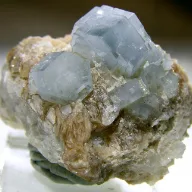 Apatite
The mineral teeth are made of, and the one that gives 5 on the Mohs scale its meaning.
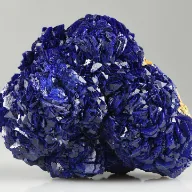 Azurite
The deep blue of copper, and the blue of half the paintings in Europe before 1700.
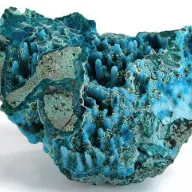 Chrysocolla
Copper turned to blue-green paste, and the flux that Bronze Age goldsmiths soldered with.
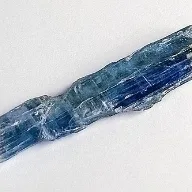 Kyanite
Blue blades with two hardnesses: soft along their length, hard across it.
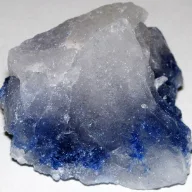 Dumortierite
A blue borosilicate that reaches the shops disguised as quartz.
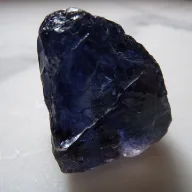 Iolite
Cordierite: violet-blue from one side, straw yellow from another.
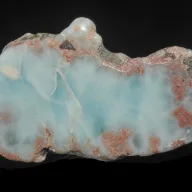 Larimar
Blue pectolite from one hillside in the Dominican Republic and nowhere else.
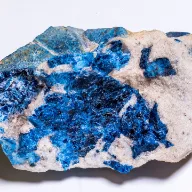 Lazulite
An azure phosphate with a name one letter away from lapis lazuli.
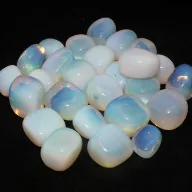 Opalite
Man-made glass, sold as a stone, and honestly rather pretty.
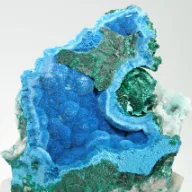 Shattuckite
A copper silicate in a blue that only copper manages, from a mine in Arizona.
 Sodalite
Royal blue veined with white, and the lapis on the shelf that is not lapis.