 Lunarya
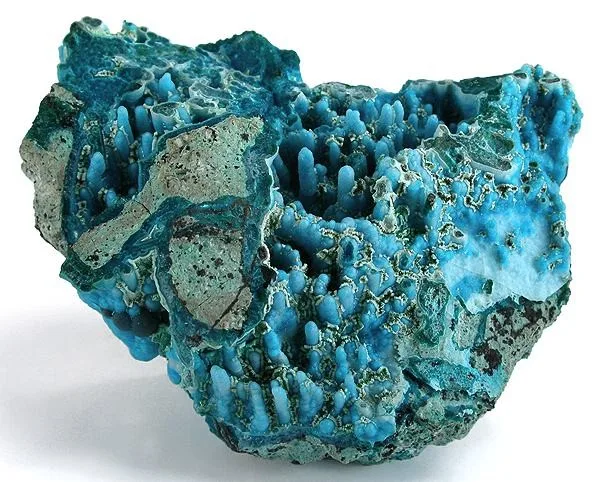
Chrysocolla
Chrysocolla is a hydrated copper silicate, and the least tidy mineral on this list: it forms crusts, botryoidal skins and earthy masses in blue, cyan and green, seldom crystallises, varies in composition from specimen to specimen and is usually mixed with something else. Pure, it is soft enough to scratch with a fingernail. Soaked through with silica, it is as hard as quartz and becomes the most expensive blue-green stone in the American southwest.
The name is Greek — chrysos and kolla, gold and glue — and it is one of the oldest mineral names still in use. Theophrastus used it around 315 BC for the flux with which goldsmiths soldered gold, a copper mineral ground up and mixed with a binder; the modern mineral inherited the name from the process. What jewellers now call gem silica is chrysocolla-coloured chalcedony: the copper acts as a pigment inside microcrystalline quartz, and the result takes a mirror polish and keeps its colour.
In short
- Colour
- Blue
- Mineral
- Silicate
- Formula
- (Cu,Al)₂H₂Si₂O₅(OH)₄·nH₂O
- Hardness
- 2–4 on the Mohs scale
- Crystal system
- Orthorhombic
- Found in
- Arizona (Ray, Inspiration and Miami), Peru, the Democratic Republic of Congo, Mexico, Israel and Chile.
- Element
- Water
- Planet
- Venus
- Chakra
- Throat
- Handling
- Keep out of water
How it forms
Chrysocolla belongs to the oxidised cap of a copper deposit. Rain and groundwater get into copper sulfides, oxidise them and carry the copper down in solution; where that solution meets silica it precipitates as chrysocolla, lining cavities and coating everything, usually with malachite, azurite, cuprite and quartz in the same few centimetres. Where silica keeps arriving afterwards, the chrysocolla is impregnated and hardened into gem silica; where it does not, the result stays as soft as chalk.
In human hands
Copper mining is six thousand years old and chrysocolla has come out of the top of every copper mine since, used as a pigment, a flux and an ornamental stone. The Eilat stone of Israel — a mix of chrysocolla, malachite and turquoise from the old workings at Timna, which tradition calls King Solomon's mines — is the national stone of Israel and is now almost entirely mined out, with imported look-alikes filling the shops. Arizona's copper boom from the 1880s produced the gem silica, and the best of it, from the Inspiration mine, is priced with fine turquoise.
Varieties and trade names
- Gem silica
- Chrysocolla-coloured chalcedony, translucent robin's-egg blue, hard and durable; the valuable form.
- Eilat stone
- A banded mixture of chrysocolla, malachite and turquoise from Timna in Israel; worked out and widely imitated.
- Chrysocolla with malachite
- Blue and green intergrown, often with black tenorite; the common decorative material.
- Parrot wing
- Chrysocolla in jasper or quartz, banded blue-green and brown, from the American southwest.
- Drusy chrysocolla
- A crust of tiny quartz crystals grown over blue chrysocolla, which sparkles and is set as-is.
Telling it from a fake
Raw chrysocolla is porous enough to stick to a wet lip and soft enough to mark with a pin; if a blue-green stone does neither, it has been silicified, resin-stabilised or is not chrysocolla. Turquoise is opaque, harder and usually more even in colour. Much of the cheap "chrysocolla" in bead shops is dyed howlite or magnesite — look for colour pooling in the veins — and some is a plastic-impregnated powder. Gem silica should be translucent when held to a lamp.
None of this needs a laboratory, and none of it is proof. A shop that will not say whether a stone is treated has answered the question; ask, and have the answer written on the receipt.
What it is said to do
A stone of the voice: the books give it for saying difficult things calmly, for teaching and for conversations one has been putting off, and it is often called a goddess stone on the strength of that. The water-blue colour drives the reading, as it does for most of the blue minerals. Nothing older survives; the ancient uses of chrysocolla were practical.
Living with it
Soft and porous unless it is gem silica: keep it out of water, oil, sweat and ultrasonic cleaners, since it will take up whatever it is soaked in and dull. Wipe it with a dry cloth. Gem silica needs none of these precautions and can be worn daily.
In magic
Chrysocolla is used in modern practice as a stone of the voice and of calm: for teaching, for difficult conversations, and in goddess and moon workings on account of its water-blue. The ancient world used the name for a gold solder and a green pigment, not for magic. It is soft and porous, so it is wiped rather than bathed; gem silica, its hard form, can go anywhere.
- Energy
- Receptive
- Day
- Friday
- Worked for
- Speaking and being heard · Calm and peace
More of this colour
 Aquamarine
Beryl the colour of shallow water, in crystals a metre long.
 Turquoise
The stone that takes up whatever you soak it in, including your hand cream.
 Lapis lazuli
A blue rock with gold in it, mined in one valley for six thousand years.
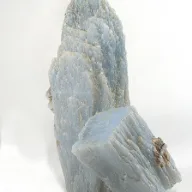 Angelite
Blue anhydrite from Peru: gypsum with the water taken out, and a name the trade gave it.
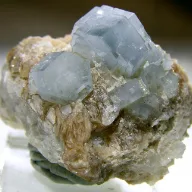 Apatite
The mineral teeth are made of, and the one that gives 5 on the Mohs scale its meaning.
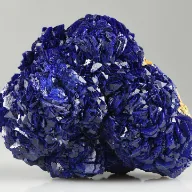 Azurite
The deep blue of copper, and the blue of half the paintings in Europe before 1700.
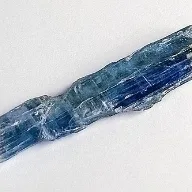 Kyanite
Blue blades with two hardnesses: soft along their length, hard across it.
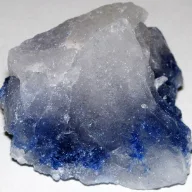 Dumortierite
A blue borosilicate that reaches the shops disguised as quartz.
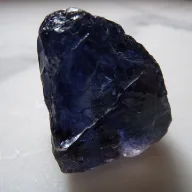 Iolite
Cordierite: violet-blue from one side, straw yellow from another.
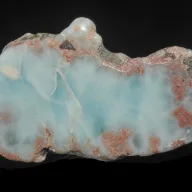 Larimar
Blue pectolite from one hillside in the Dominican Republic and nowhere else.
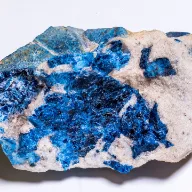 Lazulite
An azure phosphate with a name one letter away from lapis lazuli.
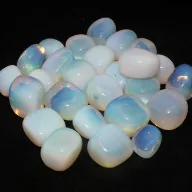 Opalite
Man-made glass, sold as a stone, and honestly rather pretty.
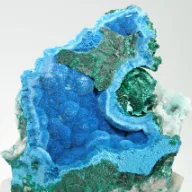 Shattuckite
A copper silicate in a blue that only copper manages, from a mine in Arizona.
 Sodalite
Royal blue veined with white, and the lapis on the shelf that is not lapis.